
Is June or July a Good Month to Hike Near Seoul?
Picture this. You’ve planned a morning hike up one of Seoul’s iconic mountains. You packed snacks, got your trail shoes on, took the subway out. You step off at the trailhead and start walking — and that’s when you notice something. A slow, drifting cloud of tiny black insects. They don’t scatter when you walk through them. They don’t fly away. They just… float toward you, completely unbothered, like they own the trail. This is the reality of love bug Korea hiking season — and it catches most visitors completely off guard.
Some hikers don’t even realize there are bugs crawling on their back until someone else points it out.
That’s a love bug. And if you’re hiking near Seoul in June or July, there’s a real chance your whole morning ends up looking like that.
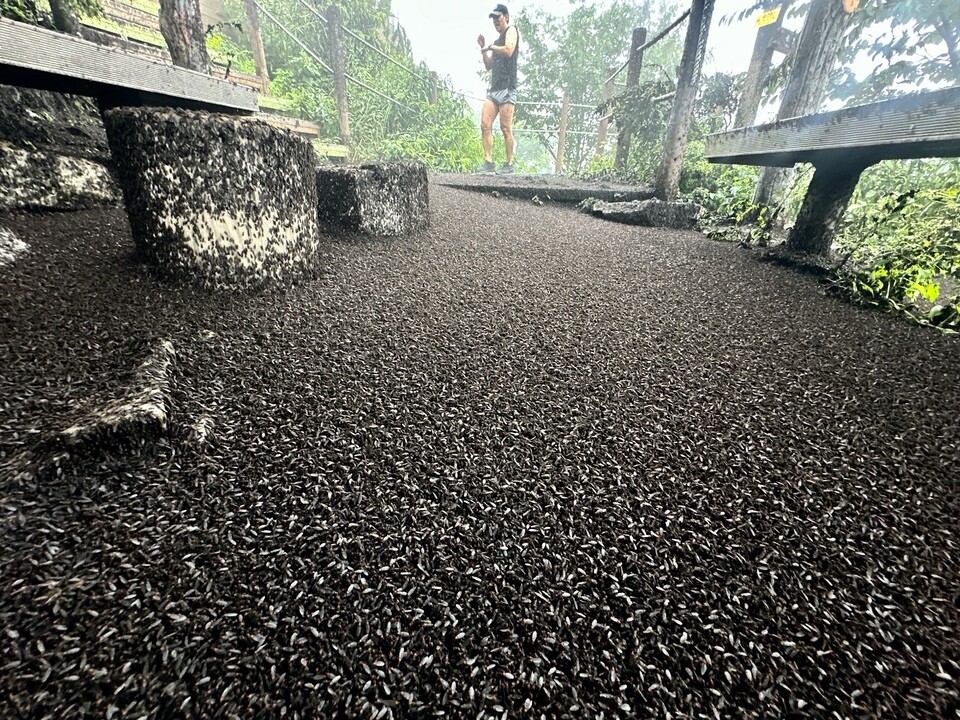
One hiker at Gwanaksan in late June 2025 didn’t make it to the summit. Photos from trails around Seoul that same period show mountains — actual peaks — so covered in love bugs that the rocks look spray-painted dark.

So What Exactly Is a Love Bug?
Small black insects with a red back, always flying in pairs — hence the name. They don’t bite. They don’t sting. They’re actually classified as beneficial insects because their larvae break down organic matter in the soil.
But here’s what matters for hikers. They move slowly and they’re not afraid of people at all — which makes the encounter feel deeply unsettling, even if you know they’re harmless. They die easily (water kills them, which is why rainy days are your best friend — they completely disappear when it rains). But in dry, humid conditions, they swarm in massive numbers for about three weeks straight, and then they’re gone.
The problem is that three-week window falls right in the middle of peak summer hiking season. And because they’re classified as beneficial insects, large-scale pesticide treatment is effectively off the table — authorities are limited to eco-friendly traps and water trucks. Complaints to Seoul city hit over 9,000 in 2024. The bugs just keep coming back, and there’s not much anyone can do about it yet.
Miss the timing and you’re hiking through a living cloud. Catch it right and you won’t see a single one.
The Mountains to Avoid in June and July
Not all mountains are equally affected — but some are significantly worse than others, based on real incident reports and government data.
Baengnyeonsan (백련산), Eunpyeong-gu — This is ground zero. Love bugs were first reported in mass numbers here, and the Eunpyeong and Mapo neighborhoods around it are consistently the worst-hit areas every summer. If you’re staying in Hongdae or Mapo and thinking of a quick nearby hike in June or July — skip this one.
Bukhansan (북한산) — Even the famous one isn’t safe. In 2025, the summit (Baegundae, 836m) was visually blanketed. The national park authority confirmed they will not apply any chemical treatment inside park boundaries. Love bugs love open, breezy ridgelines — which is exactly what Bukhansan’s granite summits offer.
Gwanaksan (관악산) — One of the worst spots in 2025. Vendors at the summit said they couldn’t open their coolers. A regular hiker described looking up and seeing the sky “gone completely black.”
Gyeyangsan (계양산), Incheon — The most extreme case documented in 2025. Bug carcasses literally piled up on the trail decking. The Ministry of Environment dispatched emergency field teams. It made national news for days.
Where to Go Instead
There’s no mountain in greater Seoul that’s been confirmed 100% love bug-free during peak season — the bugs have spread across the whole metro area. But some spots have had significantly fewer reports, for good reasons.
Suraksan (수락산) — Genuinely underrated year-round, and in love bug season it has a real advantage. It sits on the northeastern edge of Seoul, well away from the Eunpyeong and Mapo epicenter where bugs originated and where populations remain highest. The terrain features more exposed granite and multiple waterfalls — Suraksan literally means “mountain of many waterfalls” — which creates better airflow and less of the damp, leaf-litter environment love bugs thrive in. Access from Danggogae Station (Line 4). Quieter than Bukhansan on a normal day, and that gap only gets bigger in bug season.
Dobongsan (도봉산) — Further north and more exposed than Bukhansan, with dramatic granite ridges that mean less dense forest floor coverage. Less decomposing leaf habitat = fewer love bugs breeding. It’s a harder hike (expect scrambling near the top), but if you want a real mountain experience in summer without being in the worst-hit zone, Dobongsan is the smarter call. Start from Dobongsan Station (Line 1 or 7).
Cheonggyesan (청계산) — South of the Han River, well outside the northwestern origin zone, and consistently absent from love bug news coverage. A gentler mountain overall, popular with families. Not going to give you dramatic ridgeline views, but if you want a peaceful green walk in June without the bug situation, it’s a solid pick. Access from Cheonggyesan Station (Sinbundang Line).

Practical Tips If You Do Go
Timing matters as much as location. Love bugs peak in warm, humid conditions — overcast days after rain are usually worst. Clear, breezy mornings are noticeably better. And if it’s actually raining? The bugs vanish completely. A light drizzle hike in early July is often the bug-free window people don’t think to use.
Wear dark clothes. Love bugs are attracted to bright colors, especially white. It won’t solve the problem but it helps.
Regular bug spray doesn’t work on love bugs. A hat with a brim is more useful — it keeps them off your face without you having to think about it.
And honestly, if insects genuinely bother you, June and July are not your months. Seoul’s mountains in April, May, September, and October are spectacular and completely bug-free. May averages around 19°C (66°F) with clear skies. June pushes up to 24°C (75°F) with humidity climbing fast. The hiking is harder, sweatier, and buggier. But if none of that stops you — the summer green on these mountains is genuinely something. Just go in knowing what you’re walking into.